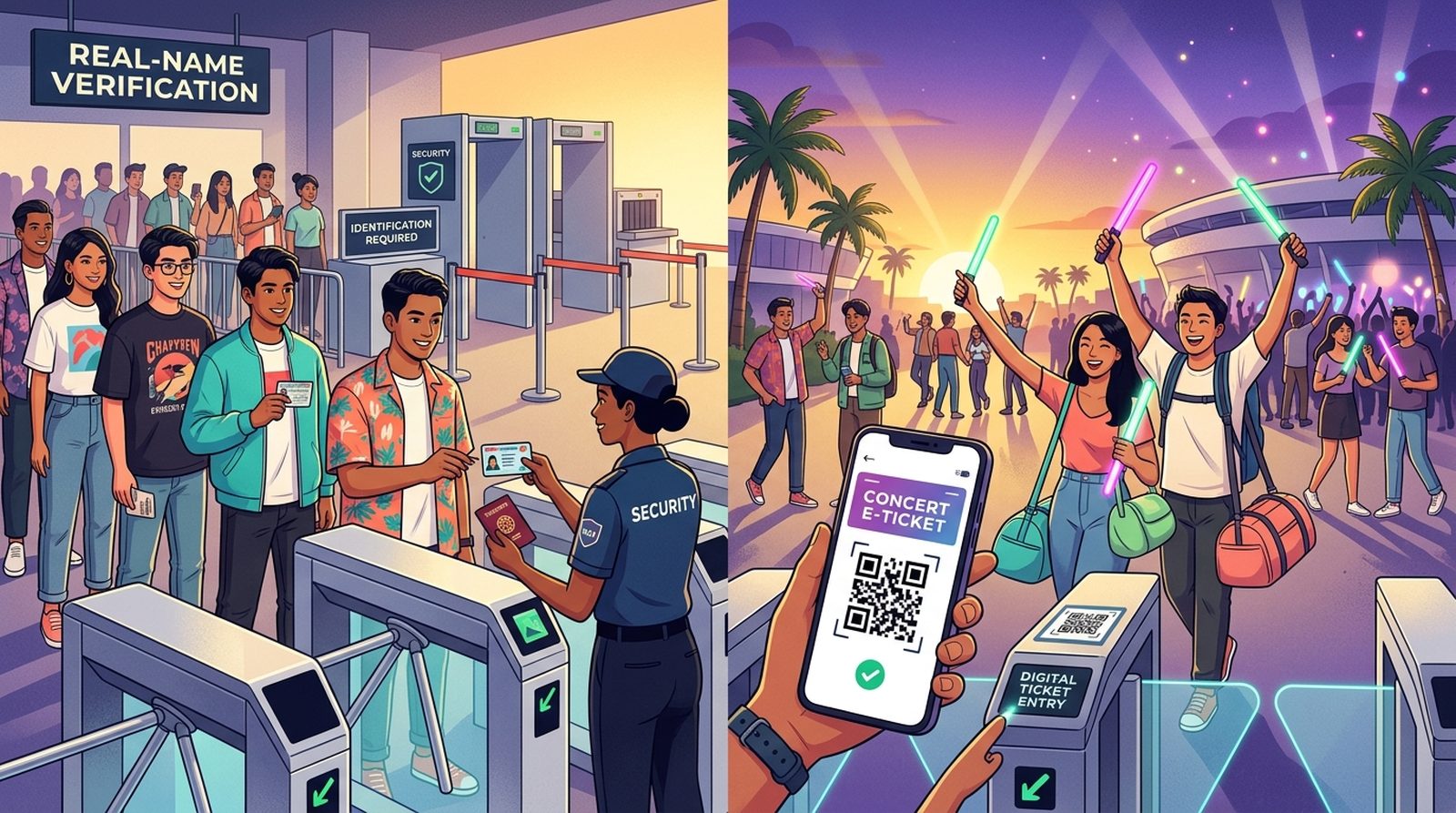
Real-name concert ticketing means your ticket is tied to your identity: you show an ID or pass a verification check to buy it, to enter, or both. It does make life harder for scalpers. But it has a cost that rarely gets discussed: every extra ID wall makes it harder for foreign fans to buy, and foreign fans are the ones who spend on flights, hotels and food. Singapore keeps concert entry light, and its tourism numbers show why.
This guide covers which Asian markets use real-name checks, what they get right, the economic downside, and what it means for Malaysians buying shows abroad. No scare stories, just how the systems work.
What “real-name verification” actually means
People use one phrase for two different checks, and it helps to keep them apart:
- Purchase ID: you must give a national ID, passport, local phone number or pass an online identity check (eKYC) to buy. The ticket may carry your name.
- Entry ID: at the gate, staff or a machine check that the person walking in is the person named on the ticket, using an ID card, passport or facial recognition.
A market can have one without the other. Many platforms collect your name and IC number at checkout but only scan a QR code at the door. It also matters who sets the rule: in a few places it is government law; in most it is the organiser or ticketing platform deciding per event.
Which countries use real-name checks? A market-by-market table
Of the eight Asian markets below, only mainland China has a nationwide government mandate covering both purchase and entry for large shows. South Korea, Japan and Taiwan mix anti-scalping laws with platform rules. Indonesia, Thailand and Malaysia leave it to organisers. Singapore generally does not bind tickets to ID at all.
| Market | ID to buy? | ID to enter? | Law or organiser policy |
|---|---|---|---|
| China (mainland) | Yes, strict: resident ID or passport, 1 ticket per ID | Yes: ID match, often facial recognition; non-transferable | Government mandate (Sept 2023) for shows over 5,000 people |
| South Korea | Yes: local phone/i-PIN for locals; passport eKYC on global sites | Often, especially K-pop, will-call and VIP | Mixed: anti-scalping law plus agency policy |
| Japan | Yes, mostly via a Japanese mobile number and app | Selective to high: app/SIM lock, ID checks on some tours | Mixed: Ticket Anti-Resale Act (2019) plus organiser rules |
| Taiwan | Event-dependent: real-name mode needs ID/passport | Event-dependent, when real-name (實名制) is switched on | Mixed: anti-scalping law (2023) plus organiser |
| Indonesia | Yes at checkout: NIK or passport | Selective: stricter for wristbands, VIP, K-pop | Organiser policy |
| Thailand | Yes: national ID or passport, name on ticket | At pickup yes; at the gate rarely | Organiser policy |
| Singapore | No ticket-level ID binding; occasional online anti-bot check | Generally no: barcode/QR scan | Organiser policy |
| Malaysia | Name and IC/passport often collected; binding varies | Selective: usually QR, some flagship shows require name-to-ID match | Organiser policy |
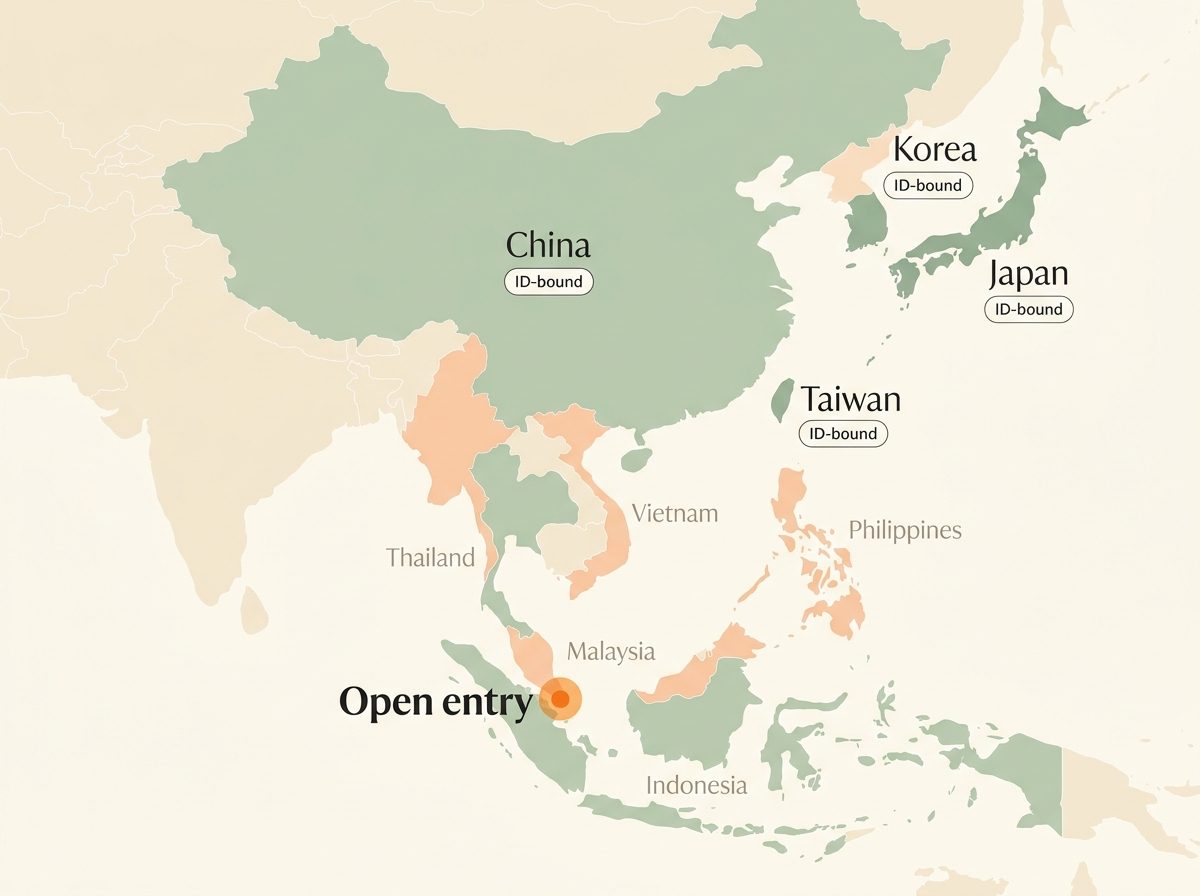
Rules change per tour, so always read the specific event’s terms. A few details worth knowing:
- China: According to Global Times (September 2023), a joint notice from the Ministry of Culture and Tourism and the Ministry of Public Security requires real-name purchase and entry for large commercial shows of more than 5,000 people. One ID buys one ticket, the buyer must be the person entering, at least 85% of tickets must go on public sale, and the remaining 15% must be bound to personal details within 24 hours before the show.
- South Korea: Korea JoongAng Daily reports Korea has raised penalties for ticket scalping. Foreign fans usually buy through separate global portals that verify passports online.
- Japan: As Japan-Dev explains, many Japanese ticket sites and apps expect a Japanese phone number, on top of the 2019 anti-resale law.
- Taiwan: Taiwan News (May 2023) covered the amendment that added fines for scalping, and organisers can switch on real-name mode for hot shows.
- Malaysia: Some big shows do go strict. For Coldplay KL 2023, Scoop.my reported name-to-ID rules and letters for tickets bought for someone else.
The benefits: why markets use real-name checks
- Harder for bots and scalpers. One ID per ticket, passport eKYC and phone-bound apps make it costly to buy in bulk.
- More tickets reach the public. China’s 85% public-sale rule (Global Times, 2023) is designed to stop tickets being held back for insiders and touts.
- Fewer fake-ticket scams. If the gate checks your ID, a duplicated PDF or a screenshot sold on social media is worthless. That removes one of the most common scams (see our guide to concert ticket scams in Malaysia).
- Official refunds and resale. Fans who cannot go are pushed towards official refund or resale channels instead of the grey market.
- Easier enforcement. In Taiwan and Korea, where scalping carries fines, named tickets make offenders easier to trace.
The downside: the economic cost of strict ID
This is the part that gets less attention. A concert is not just a ticket sale. A fan who flies in for a show also pays for flights, a hotel, meals, transport and shopping. Anything that stops that fan from buying a ticket also stops that spending.
1. Friction pushes foreign buyers away
Strict systems are built around local documents. In Japan you often need a local phone number. In Korea foreigners are sent to separate global sites where passport verification can fail. On top of that come card rejections, unfamiliar languages and sale times set for the local time zone. Each step is small; together they put off a lot of casual overseas fans. The ones who keep going spend hours on it, or give up.
2. Tourism spending moves elsewhere
When one market is hard to buy in and another is easy, regional fans pick the easy one, and their travel budget goes with them. This is a reasoned argument, not a measured figure: no tourism board we found has published how much money is lost only because of real-name ticketing. But the direction is clear, and Singapore’s numbers (below) show how much is at stake.
3. “Ghost seats” at sold-out shows
If a ticket cannot be transferred and the refund deadline has passed, a fan who falls sick or cannot travel simply does not come. There are reports from China of empty seats at “sold-out” shows for this reason. There is no official figure for how common it is, but every empty seat is also an unsold drink, merch item and hotel night.
4. Higher running costs
Checking passports by hand needs more staff and slower lanes than scanning a QR code. That cost lands on organisers and, eventually, on ticket prices.
5. It doesn’t fully kill scalping
Scalpers adapt. Instead of reselling tickets, some “daipai” (代拍) services ask buyers to hand over their own ID details and then snipe tickets in their name. Taipei Times (2026) reported on real-name bypass schemes and raids in Taiwan. So the market ends up with the economic friction and a grey market, just a different one, where fans hand personal data to strangers.
Singapore: why the tourism hub keeps entry light
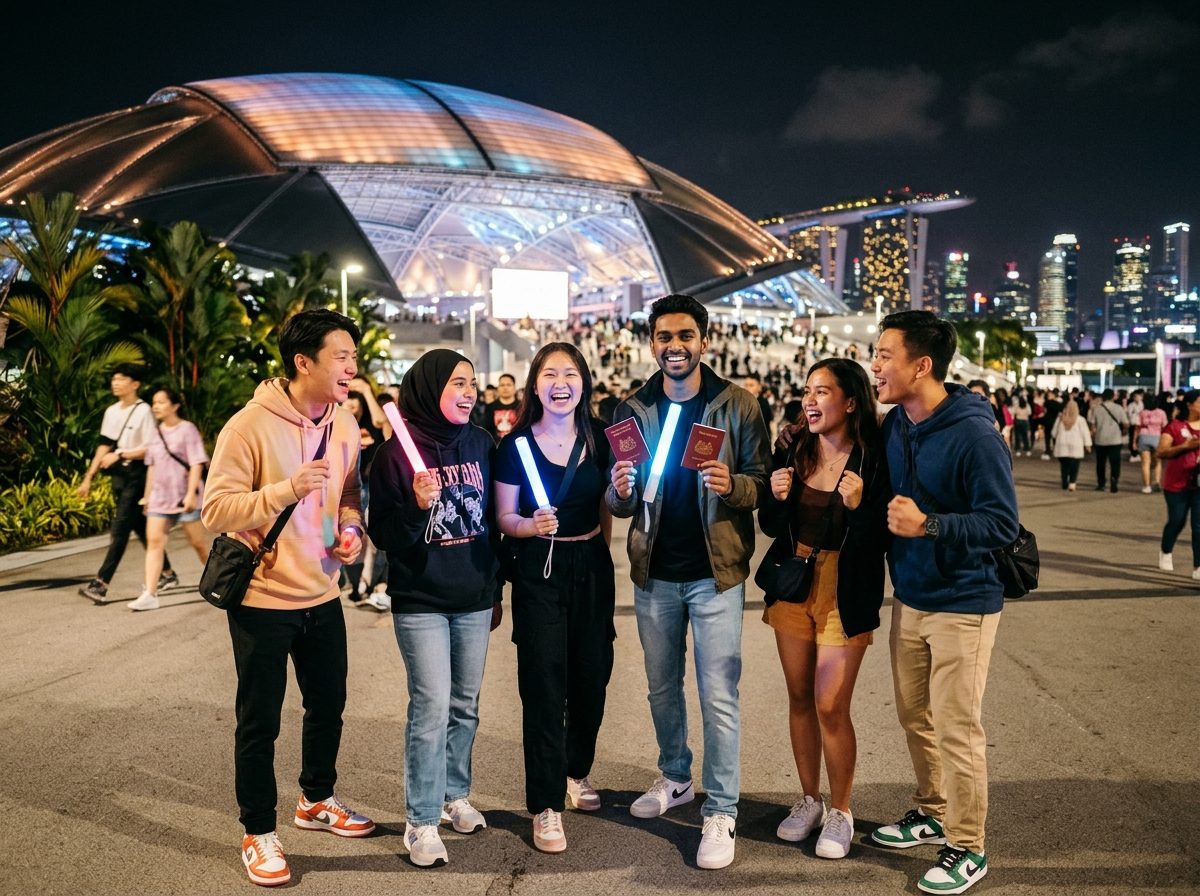
Singapore takes the opposite approach. For big stadium shows, general entry is a barcode or QR scan, not a Korea- or China-style passport match at the gate. The numbers suggest why that suits the country.
According to CNA (26 April 2024), the Monetary Authority of Singapore said the Coldplay and Taylor Swift concerts drove a surge in tourism in the first quarter of 2024, with more than half of the audience likely coming from abroad. Private-sector analysts cited in the same report estimated S$350 million to S$450 million in tourism receipts from those concerts, and hotel occupancy went up.
Now picture the same shows run like Seoul or Shanghai: foreign fans needing a local phone number or a passport that must match an account, a sale opening at an inconvenient hour for their time zone, then a manual ID check at the gate. Many would not spend the time and mental energy to get through it, and some of that S$350–450 million would never arrive. When most of your audience is foreign, making it easy for foreigners to buy is good economics. Singapore’s open model reflects that, even though it has no official statement that this is the reason.
One clarification: Ticketmaster Singapore sometimes asks for a security check through Persona. Its help page describes this as account security against bots. It is an online check on the account, not a real-name match at the gate. Singapore is “light”, not “no checks at all”, and a few VIP packages may still ask for ID.
What this means for Malaysian fans buying abroad
- Singapore: the easiest overseas market for Malaysians. Same time zone, Malaysian cards usually work, entry is QR. The challenge is competition, not ID.
- Korea and Japan: budget extra time for global-site sign-ups, passport checks or a local phone number, and expect ID checks at pickup or entry. Bring the exact passport you registered with.
- China: the ticket must be in the name of the person entering. Buying for a friend means using their ID, not yours.
- Taiwan, Thailand, Indonesia and Malaysia: check each show. Some are open QR, some switch on name-to-ID matching for hot tours.
- Never hand your passport or IC details to an unknown “daipai” seller on social media. In a real-name market, that is your identity and your ticket in one.
If you can buy directly on the official platform, do that. Our guide to Malaysian concert presales covers how the sale stages work, and proxy vs reseller vs buying it yourself compares your options honestly.
For cross-border shows where the friction is the hard part (foreign sign-ups, time zones, unfamiliar platforms), Beliticket can help as a third-party concierge. We are not an official or approved seller for any organiser, organiser terms may restrict third-party purchases, and we cannot get round a real-name entry rule: the ticket still has to match the person entering. Read how Beliticket works and refunds, see how it works, or browse current shows.
FAQ
Which countries require real-name verification for concerts?
Mainland China is the strictest: since September 2023, shows of more than 5,000 people need real-name purchase and entry, one ticket per ID (Global Times, 2023). South Korea, Japan and Taiwan combine anti-scalping laws with platform ID or phone checks. Indonesia, Thailand and Malaysia use ID per event at the organiser’s choice. Singapore generally uses barcode/QR entry without binding tickets to ID.
Does Singapore check ID at concerts?
Generally no. Big Singapore concerts scan a barcode or QR code at entry. Ticketmaster Singapore may ask for an online Persona security check on your account, but that is anti-bot account security, not a name check at the gate. Some VIP packages can be exceptions.
Does real-name ticketing stop scalpers?
It reduces bulk buying and fake-ticket scams, but it does not stop scalping completely. Some services ask buyers for their ID details and buy in their name instead, which Taiwan has reported raids on (Taipei Times, 2026).
What is the economic downside of real-name concert tickets?
Strict ID rules make it harder for foreign fans to buy, and foreign fans bring tourism spending. In Singapore, more than half of the Coldplay and Taylor Swift audience in Q1 2024 likely came from abroad, with analysts estimating S$350–450 million in tourism receipts (CNA, 2024). Strict systems also risk empty “sold-out” seats and higher gate staffing costs. No official figure isolates the money lost to real-name rules alone.
Can a Malaysian buy tickets for a real-name concert in China or Korea?
Usually yes, with a passport, through the platform’s global or foreigner route, but the ticket must be in the name of the person attending and you should bring that same passport. Never give your ID to an unknown reseller.